

 Aug 22, 2026
 6 min read
The Malwiya Minaret of Samarra: The Spiral Tower of the Abbasid Caliphate
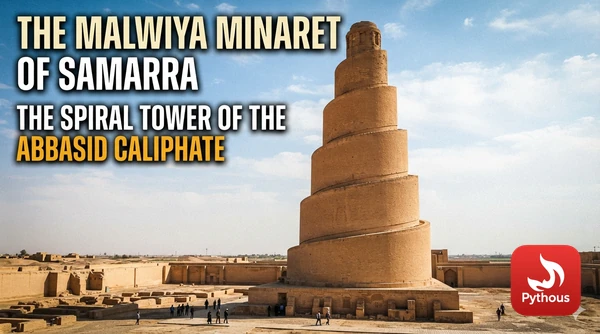
There is no other building in the Islamic world quite like it. Rising from the flat brown plain north of Baghdad, the Malwiya Minaret is a cone of baked brick wrapped in a single ascending ramp, climbing roughly fifty-two metres into the Iraqi sky with no interior staircase and no ornament to speak of. It looks less like a minaret than a piece of geometry left behind by a vanished empire — which, in a sense, is exactly what it is.
The tower is the most recognisable surviving fragment of Samarra, the city that served as the capital of the Abbasid Caliphate for a little over half a century. Its story is worth telling in full, because it explains something that architecture books rarely make clear: why the largest mosque on earth was built in a city that was abandoned within two generations.
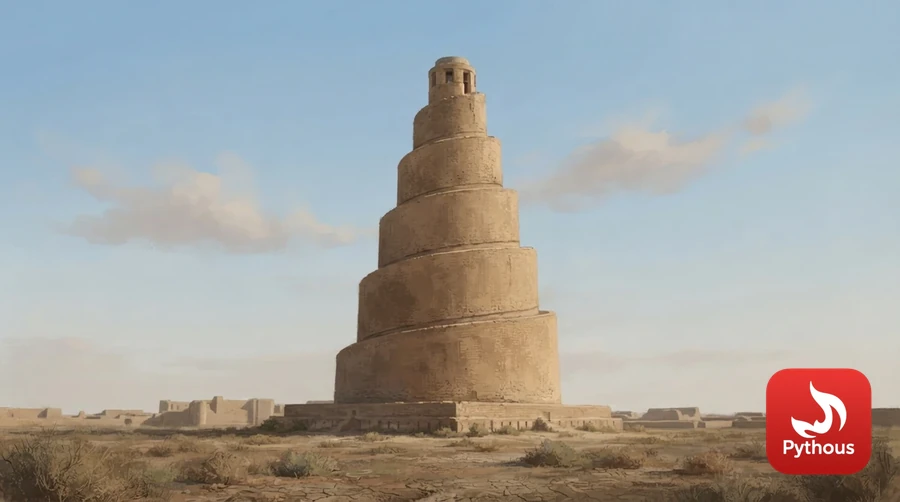
Illustration: the Malwiya, a 52-metre spiral minaret built in the 850s.
Why the Abbasids Left Baghdad
Baghdad was, by the early ninth century, the wealthiest city in the world. It was also becoming ungovernable for its own rulers.
The Caliph al-Mu'tasim, who came to power in 833, had built his military strength around Turkish slave-soldiers recruited from Central Asia. They were loyal to him personally rather than to the Arab and Persian factions that dominated Baghdad, which was precisely the point — and precisely the problem. Friction between these troops and the Baghdad population grew severe enough that in 836 the caliph moved his entire court roughly 125 kilometres upriver along the Tigris and founded a new capital.
He called it Surra Man Ra'a, "he who sees it is delighted" — a courtly play on the older place name Samarra, which long predated the Abbasids. The new city was not a fortress but a sprawl: palaces, barracks, racecourses, canals and administrative quarters stretched for more than thirty kilometres along the river. For fifty-six years, from 836 to 892, the orders that governed an empire reaching from North Africa to Central Asia were issued from here.
The Largest Mosque in the World
The Great Mosque of Samarra was commissioned by al-Mu'tasim's son, the Caliph al-Mutawakkil, and built between roughly 848 and 852. It was, at completion, the largest mosque anywhere — a rectangle of baked brick enclosing close to seventeen hectares, its outer wall running some 240 metres by 156 metres, reinforced by dozens of semicircular bastion towers.
The scale was not decorative excess. A congregational mosque in an Abbasid capital had to physically hold the assembled male population of the city for Friday prayer, and Samarra's population had swollen with soldiers, administrators, servants and merchants. The prayer hall itself was a forest of supports carrying a flat wooden roof; the courtyard beyond it was left open to the sky.
Today almost none of that survives. The walls stand, the bastions stand, and the ground plan is legible from the air. The roof, the columns and the interior are gone. What remains standing to full height, about 27 metres north of the mosque wall, is the minaret.
The Design of the Malwiya
Malwiya means "twisted" or "coiled" in Arabic, and the name describes the building exactly. A square brick plinth roughly 33 metres on each side supports a tapering cylindrical body. Around that body a single ramp, about two metres wide, winds counterclockwise upward through five diminishing stages to a small cylindrical chamber at the summit.
There is no interior. The ramp is the building's only route up and its only structural logic — the climb is the architecture.
Where the form came from is one of the more genuinely open questions in Islamic art history. The obvious comparison is the Mesopotamian ziggurat, and the region around Samarra had visible ziggurat ruins long before the Abbasids arrived. Some scholars have argued for direct influence; others point out that the ziggurat's stepped terraces and the Malwiya's continuous spiral are quite different solutions to quite different problems, and that the resemblance may be a matter of shared landscape rather than shared design. The debate has never been settled, and honest accounts leave it open.
What is clear is that the form was repeated. The nearby Abu Dulaf Mosque, built by the same caliph at Ja'fariyya a few years later, carries a smaller spiral minaret of the same family. Two examples in one reign suggests a deliberate architectural statement rather than a one-off experiment.
Whether the tower was ever practically used for the call to prayer is debated too. Fifty-two metres is a long climb five times a day, and some historians read the Malwiya primarily as a monument of caliphal authority — visible across the plain, announcing the presence of the state as much as the hour of prayer.
Decline, Rediscovery, and Damage
Samarra's fall was as abrupt as its founding. In 892 the Caliph al-Mu'tamid returned the capital to Baghdad, and the enormous city built to serve the court simply emptied. Mud-brick quarters dissolved back into the plain. What survived did so because it was built in fired brick — the mosque walls, the palace foundations, the Malwiya.
The site did not vanish entirely from significance. Samarra remained an important pilgrimage destination as the burial place of the tenth and eleventh Shia Imams, Ali al-Hadi and Hasan al-Askari, whose shrine complex stands a short distance from the old mosque and draws visitors to this day.
Systematic archaeology at Samarra began in earnest in the early twentieth century, and the sheer preservation of the abandoned city — an imperial capital frozen at the moment it was left — made it one of the most important Islamic archaeological sites in the world. UNESCO inscribed Samarra Archaeological City as a World Heritage Site in 2007, and placed it on the List of World Heritage in Danger at the same time, reflecting the conditions of the Iraq war then underway.
The Malwiya did not escape that war. In April 2005 an explosion damaged the upper section of the tower; coalition forces had earlier used the summit as an observation and sniper position, which made it a target. The minaret survived, but the episode is a reminder of how thin the margin of survival is for a building that has already outlasted its city by eleven centuries.
Visiting and Seeing It Today
Samarra sits in Iraq's Salah al-Din province, reachable by road from Baghdad in around two hours. Access has varied considerably with the security situation, and anyone planning a visit should check current conditions rather than rely on any single account.
For most readers, the Malwiya will be an image rather than a climb — but it is worth looking at properly. Almost every element of ninth-century Samarra that was meant to impress has disappeared: the palaces, the gardens, the racecourses, the court. What survives is the one structure that impresses through pure form, with no marble, no mosaic and no inscription. A spiral of brick, still standing where a capital used to be.
Frequently Asked Questions
How tall is the Malwiya Minaret? Approximately 52 metres, standing on a square base roughly 33 metres on each side.
Who built the Great Mosque of Samarra? The Abbasid Caliph al-Mutawakkil, between roughly 848 and 852 CE.
Why is the minaret spiral-shaped? Its origin is debated. Comparisons with Mesopotamian ziggurats are common but contested; the spiral ramp may equally reflect an original Abbasid solution to building height without an internal stair.
Is the Malwiya Minaret still standing? Yes. Its upper section was damaged by an explosion in 2005, but the tower remains intact and is part of the Samarra Archaeological City UNESCO World Heritage Site.
Was Samarra ever the capital of the Islamic world? Yes — it served as the Abbasid capital from 836 to 892 CE, before the court returned to Baghdad.



Comments (0)
Leave a Reply
Log in to post a comment.