

 Oct 14, 2025
 7 min read
The Gods of Ancient Egypt: Powers, Stories, and Eternal Legacy

🏺 The Gods of Ancient Egypt: Stories, Powers, and the Eternal Balance of Life
Across the golden sands and the eternal flow of the Nile, the people of ancient Egypt built one of the most remarkable civilizations in human history. But behind their temples, pyramids, and rituals was a belief system woven deeply with myth and magic — a divine order ruled by powerful gods and goddesses.
Each deity had a story, a purpose, and a lesson for humanity. Their myths were not just tales of gods; they were reflections of life, nature, and the mystery of death.
Let’s journey back thousands of years to explore the great gods of Egypt — the beings who shaped the heavens, guarded the underworld, and taught mortals the meaning of harmony and rebirth.
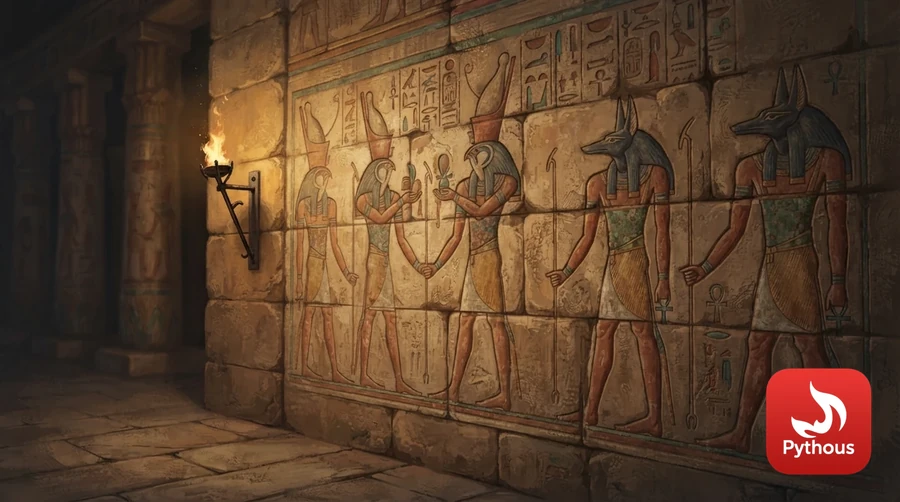
Illustration: Egyptian gods such as Horus and Anubis, as shown on temple walls.
☀️ Ra — The Sun God and Creator of All Life
When the first dawn broke over the desert, it was Ra who brought light to the world. To the Egyptians, he was the creator of life, the god who sailed his golden boat across the sky every day and descended into the underworld every night to battle darkness itself.
His daily journey symbolized the endless cycle of birth, death, and renewal — a reminder that every sunrise was a victory over chaos. Pharaohs called themselves the “Sons of Ra,” believing they carried his divine power to rule with wisdom and strength.
Even after thousands of years, the idea of Ra still burns bright — a symbol of endurance and light against the shadows of time.
🦅 Horus — The Falcon God of the Sky and Kingship
High above the Nile, where the falcon soars, lives the spirit of Horus, the god of the sky. His sharp eyes watched over the land and its people, guarding Egypt from evil.
Horus was the son of Isis and Osiris, born from a tale of love and tragedy. After his father was slain by the god Set, Horus fought to reclaim the throne of Egypt. Their battle lasted for years — a war between order and chaos. In the end, Horus triumphed, restoring balance and justice.
His symbol, the Eye of Horus, came to represent protection and healing. Egyptians wore it as an amulet, believing it shielded them from harm. To this day, it remains one of the most recognized symbols from ancient Egypt.
🌿 Osiris — Lord of the Afterlife and Eternal Resurrection
No story in Egyptian mythology is more powerful than that of Osiris. Once the kind and noble king of Egypt, Osiris was betrayed by his jealous brother Set, who murdered and dismembered him.
But his devoted wife, Isis, refused to accept his death. Through love and divine magic, she reassembled his body and brought him back to life — not as a man, but as the god of the afterlife.
Osiris became ruler of the underworld, guiding souls through judgment and offering them rebirth. His story became a symbol of hope — that death was not the end, but the beginning of a new journey.
🌙 Isis — The Goddess of Magic, Love, and Motherhood
Among all the deities, Isis was perhaps the most beloved. She was the goddess of magic, healing, and protection, but above all, she represented love — the kind that conquers death itself.
As wife of Osiris and mother of Horus, she embodied devotion and wisdom. When Osiris was slain, it was Isis’s determination and magical skill that restored him. Egyptians prayed to her for healing, safe childbirth, and family harmony.
Temples dedicated to Isis stood across Egypt, and her worship later spread through Greece and Rome. Even beyond Egypt’s borders, she remained the divine mother figure — gentle, strong, and eternal.
⚡ Set — The God of Storms and Chaos
In every creation, there is balance — light cannot exist without darkness. In Egyptian myth, Set represented that shadow side. He was the god of deserts, storms, and conflict — fierce and unpredictable.
Though he murdered his brother Osiris, Set was not purely evil. The Egyptians saw him as a necessary force — the embodiment of chaos that made order meaningful. In some tales, Set even fought alongside Ra, defending the sun god against the serpent of darkness, Apophis.
Set reminds us that even chaos has a role in maintaining balance — that struggle and conflict often bring growth and renewal.
⚖️ Anubis — The Guardian of the Dead
When the sun set for the last time and a person’s heart ceased to beat, it was Anubis, the jackal-headed god, who awaited them. He was the guardian of the dead and the protector of tombs.
Anubis guided souls to the Hall of Truth, where their hearts were weighed against the Feather of Ma’at — the symbol of justice and truth. Only those whose hearts were pure could pass into paradise.
To the Egyptians, Anubis was not a god of fear but of peace. He ensured that death was orderly, dignified, and fair — a gateway, not an end.
🐈 Bastet — The Gentle Protector of Homes
Graceful yet fierce, Bastet was the cat goddess who guarded homes and families. She was both loving and powerful — a symbol of beauty, fertility, and protection.
In early times, she appeared as a lioness, but later, her form softened into that of a domestic cat. Egyptians kept cats in their homes as sacred animals, believing Bastet watched over them.
Her festivals were joyous celebrations filled with music, dance, and perfume — honoring life, love, and comfort. Bastet was proof that divinity could also be gentle and nurturing.
📜 Thoth — The God of Wisdom and Writing
Every civilization has a keeper of knowledge, and for Egypt, it was Thoth. With the head of an ibis, Thoth was the god of wisdom, writing, and the moon.
He recorded the decisions of the gods and the judgment of souls. He was said to have invented writing, mathematics, and timekeeping. Without Thoth, the universe would fall into confusion, for he kept balance through logic and understanding.
In essence, Thoth was the divine scholar — the mind that guided the cosmos.
🦁 Sekhmet — The Lioness of Fire and Healing
Born from the fiery eye of Ra, Sekhmet was a goddess of war and destruction — yet also of healing. Her power was so great that her rage once nearly wiped out humanity.
To stop her, Ra tricked her by dying beer red to resemble blood. Sekhmet drank it, fell asleep, and awoke transformed — calmer, more compassionate. From then on, she was worshiped not just as a warrior, but as a healer, showing that even the fiercest heart can find peace.
🌌 Ma’at — The Goddess of Truth and Balance
To the Egyptians, the universe existed because of Ma’at — the divine order that kept everything in harmony. She was not only a goddess but a principle, representing truth, justice, and moral balance.
Every pharaoh was sworn to uphold Ma’at, for when order was broken, chaos (Isfet) would return. In the afterlife, each soul’s heart was weighed against Ma’at’s feather — a perfect measure of one’s truth in life.
Without Ma’at, there was no Egypt — no sunrise, no Nile, no justice. She was the invisible heartbeat of creation.
🌿 The Eternal Balance
In Egyptian mythology, the gods were not distant rulers but living forces of nature and spirit. They were present in the river’s rise, the desert’s silence, the stars above, and the heartbeat of every living being.
Each god — whether kind like Isis or wild like Set — taught a lesson about balance, courage, and transformation.
Thousands of years may have passed, but their voices still echo through time. The gods of Egypt remind us that life is a cycle — of creation and destruction, of love and loss — and that within this cycle lies the beauty of eternity.
✨ In every sunrise, Ra still rises. In every river’s flow, Osiris still breathes. And in every act of truth, Ma’at still lives.


Comments (0)
Leave a Reply
Log in to post a comment.