

 Aug 14, 2026
 13 min read
Quaid-e-Azam Muhammad Ali Jinnah: The Lawyer Who Built a Nation
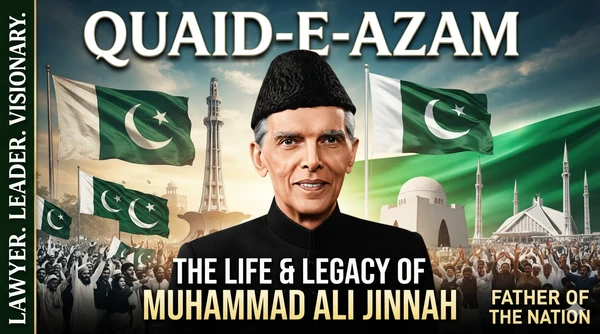
admission register suggests a slightly earlier year — a small mystery that biographers still note. His father, Jinnahbhai Poonja, ran a trading business, and young Jinnah grew up in a home that valued commerce, discipline, and ambition.
He was not, by his own family's account, a particularly studious child. He disliked arithmetic and was more interested in horses and the outdoors than in his schoolbooks. He studied first at the Sindh Madrasatul Islam and later at the Christian Missionary Society High School in Karachi, before his father decided to send him to England — not to study law, but to gain business experience with a shipping firm.
Before he left for London at the age of sixteen, Jinnah was married, as per the custom of the time, to a young relative named Emibai. She passed away while he was still abroad, one of several personal losses — his mother's death followed soon after — that shaped his famously private, guarded temperament in later life.

Illustration: London's Inns of Court, where Jinnah trained as a barrister in the 1890s.
The London Years: From Apprentice to Barrister
Jinnah's father had sent him to London to apprentice with Graham's Shipping and Trading Company. But London changed his ambitions. He abandoned the business apprenticeship, much to his father's disapproval, and enrolled at Lincoln's Inn to study law instead. According to the Inn's own archives, part of what drew him was a mural in the main hall depicting Moses holding the Ten Commandments — a symbol, Jinnah later said, of the moral seriousness he attached to law and justice.
In London he lived a modest, disciplined life: he dressed immaculately, read voraciously, and spent hours in the public gallery of the House of Commons watching parliamentary debates. He was particularly struck by the oratory of Dadabhai Naoroji, the first Indian to sit in the British Parliament, and admired liberal statesmen like William Gladstone. These years quietly built the political instincts — a taste for constitutional method over street agitation — that would define his entire career.
He was called to the Bar in 1896, in his early twenties, becoming one of the youngest Indians of his generation to qualify as a barrister at Lincoln's Inn.
Building a Legal Empire in Bombay
Jinnah returned to India in 1896 to find his family's business in decline and his mother and young wife both dead. Rather than return to Karachi, he enrolled at the Bombay High Court and began building a legal practice almost from nothing. According to his own recollection, his early years at the bar were lean — but his fortunes changed once he came to the attention of Bombay's Advocate General, John Molesworth Macpherson, who began referring cases to him.
Within a decade, Jinnah was one of the most sought-after barristers in Bombay, commanding some of the highest fees in the city. He argued cases before the Bombay High Court and the Privy Council in London, representing everyone from wealthy industrialists to nationalist politicians. He briefly served as a Presidency Magistrate in 1900, but chose to return to private practice rather than pursue a judicial career, valuing the courtroom over the bench.
His most famous cases became part of Bombay legal folklore:
- The Caucus Case (1908) — a dispute over alleged rigging in Bombay's municipal elections, in which Jinnah represented the prominent leader Sir Pherozeshah Mehta and built his reputation as a fearless, meticulous advocate.
- The defence of Bal Gangadhar Tilak — Jinnah defended the Congress leader Tilak on sedition charges, first unsuccessfully in 1908, and then successfully in a later trial in 1916, cementing his image as a lawyer unafraid of taking on the colonial government.
- The Bawla Murder Trial (1925) — a sensational case involving a wealthy industrialist's family that drew national press attention and further burnished his reputation as one of India's finest criminal lawyers.
Contemporaries who watched him in court described a very particular kind of performer: understated, economical with words, but devastating in his timing. The journalist Frank Moraes wrote admiringly that few lawyers could command a courtroom's attention the way Jinnah did, achieving maximum effect with minimum effort. Fellow barristers called him "the magician with the monocle" — a nod to the single eyeglass he was rarely seen without, and which became something of a personal trademark.
Stories of His Wit and Intelligence
Jinnah's sharp mind and even sharper tongue produced a small treasury of courtroom anecdotes that lawyers in Bombay and Karachi still repeat today.
The Monocle Story. In one hearing, Jinnah's monocle slipped and fell to the floor while he was making an argument. The presiding magistrate, no friend of his, smiled to himself — certain that the dignified barrister would now have to stoop undignified to retrieve it. Instead, without breaking his argument, Jinnah calmly reached into his pocket, pulled out a spare monocle, fitted it to his eye, and carried on as if nothing had happened.
"Not a Third-Class Counsel." During one heated exchange, an irritated judge snapped that Jinnah was not addressing a "third-class magistrate." Jinnah shot back instantly that there was, in that case, no third-class counsel before the bench either — a reply as fast as it was fearless, delivered to a judge who held his professional future in his hands.
On judicial impartiality. After Justice Davar sentenced Tilak to six years of rigorous imprisonment and was subsequently knighted by the colonial government, the Bombay Bar Association planned a celebratory dinner in his honour. When the circular inviting lawyers to sign up reached Jinnah, he refused pointedly, arguing that the profession should be ashamed to honour a judge for delivering the sentence the government wanted. When Davar later summoned him privately to ask how he felt he had been treated in his court, Jinnah answered, without hesitation, that he had always been treated fairly — his objection was to principle, not to personal grievance.
On mentorship. When a close friend once asked Jinnah to take his newly qualified barrister son into his chambers and "make him a good lawyer," Jinnah agreed readily — but added a line that became famous among his juniors: he could teach the young man everything he knew, but he could not hand over his own brilliance; the young man would have to build his own.
These stories capture the essential Jinnah: unflappable under pressure, precise with language, allergic to sentimentality, and quietly, relentlessly proud.
From Barrister to Politician: The "Ambassador of Hindu-Muslim Unity"
Jinnah's political career began around 1906, when he joined the Indian National Congress. Unlike many of his contemporaries, he entered politics as a committed constitutionalist — someone who believed change should come through legislative councils, negotiation, and legal argument rather than mass agitation.
For nearly three decades, Jinnah worked to bring India's two largest communities together. His defining achievement in this period was the Lucknow Pact of 1916, an agreement he helped broker between the Congress and the All-India Muslim League (which he had joined in 1913) that set out a joint political platform and secured separate electorates for Muslims. It was for this work that the poet and politician Sarojini Naidu famously called him the "Ambassador of Hindu-Muslim Unity" — a title that would look almost ironic in hindsight, given how his politics later evolved.
In 1929, in response to the Nehru Report's failure to accommodate Muslim political demands, Jinnah put forward his Fourteen Points — a set of constitutional safeguards covering federalism, minority representation, and religious rights that he believed were essential for any future Indian constitution. When the Congress and other parties showed little appetite for these safeguards, a disillusioned Jinnah largely withdrew from active Indian politics during the early 1930s, spending several years practising law in London rather than in Bombay.
The Return, the Muslim League, and the Two-Nation Theory
Jinnah was persuaded to return to India in the mid-1930s, largely at the urging of Muslim League colleagues who believed only he could rebuild the party into an effective political force. He threw himself into reorganising the League, which had until then been a relatively weak and fractured organisation compared to the mass-based Congress.
The turning point came with the provincial elections of 1937, in which the Congress won outright majorities in several provinces and formed governments largely without Muslim League participation. Over the following two years, League leaders documented a growing list of grievances about the treatment of Muslims under Congress-led provincial administrations. For Jinnah, this period confirmed a conviction that had been building for years: that Muslims could not rely on the goodwill of a Hindu-majority Congress to protect their political future in a unified, independent India.
This conviction found its fullest expression at the Muslim League's session in Lahore in March 1940. Speaking at Minto Park before a vast crowd, Jinnah argued that Hindus and Muslims were not simply two communities within one nation but two distinct nations altogether — with different religions, philosophies, customs, and historical experiences — and that trying to force them into a single constitutional structure would only produce permanent unrest. On his call, the League passed what came to be known as the Lahore Resolution (later the Pakistan Resolution), demanding that regions where Muslims formed a majority — in the northwest and the east of British India — be constituted as independent states.
It was around this period that Jinnah began to be addressed by his followers as Quaid-e-Azam — the "Great Leader" — a title that stuck for the rest of his life and beyond.
The Road to Partition
The 1940s brought a rapid, often brutal acceleration toward the division of India. Jinnah and the Muslim League initially accepted the British Cabinet Mission Plan of 1946, which proposed a loosely federated, united India. When Congress leader Jawaharlal Nehru publicly suggested the Constituent Assembly would be free to modify the plan's terms, Jinnah — convinced Congress could not be trusted to honour any power-sharing arrangement — withdrew his support and announced that the League would pursue "Direct Action" to achieve Pakistan.
Direct Action Day, called for August 16, 1946, was intended as a mass strike to demonstrate Muslim political strength. In Calcutta, where tensions were already dangerously high, it exploded into days of horrific communal violence — remembered as the Great Calcutta Killings — in which thousands were killed. The bloodshed spread to Noakhali, Bihar, and other regions, and is widely seen by historians as the point after which a united, undivided India ceased to be a realistic possibility.
With violence spiralling and British authority crumbling, Lord Louis Mountbatten arrived in 1947 as the last Viceroy of India, tasked with arranging a rapid transfer of power. Negotiations between Mountbatten, Jinnah, Nehru, and Gandhi (who bitterly opposed partition, at one point calling it a wound inflicted on the body of India) ultimately produced the Mountbatten Plan of June 3, 1947, accepted by both the Congress and the Muslim League. It led directly to the Indian Independence Act of 1947, which created two new dominions — India and Pakistan — and dissolved nearly two centuries of British rule on the subcontinent.
Pakistan came into being on August 14, 1947. Muhammad Ali Jinnah, the constitutionalist lawyer who had spent decades arguing cases before British judges, was sworn in as its first Governor-General.
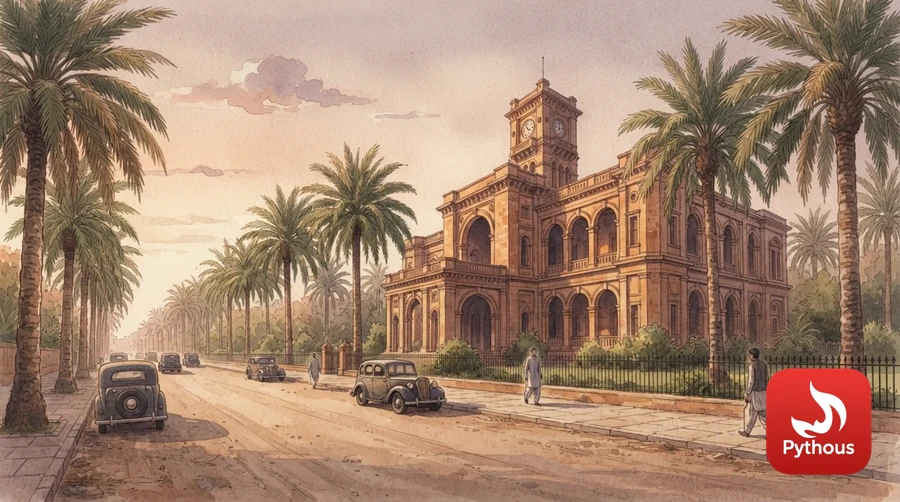
Illustration: Karachi in 1947, capital of the new state of Pakistan.
Governor-General of a New Nation
Jinnah's time as Governor-General lasted barely thirteen months, but he packed it with an intensity that stunned even those closest to him. He chaired cabinet meetings personally, visited refugee camps in Lahore and elsewhere as millions of people crossed the new borders in one of the largest and most violent mass migrations in history, and made clear his expectations of the officials now running the new state — never hiding his disappointment when they fell short.
What almost no one around him knew was that Jinnah had been secretly battling tuberculosis since 1930 — nearly two decades. He had confided the diagnosis only to his sister, Fatima Jinnah, and a tiny circle of trusted associates, and had deliberately kept it from political friends and rivals alike. According to those close to him, his reasoning was blunt: he did not want his opponents to simply wait him out. He drove himself at a pace that alarmed his doctors, and by the time Pakistan was created, his health had already begun to fail badly.
The Final Days and Death
By the summer of 1948, Jinnah's condition had deteriorated sharply. Doctors confirmed not only advanced tuberculosis but also evidence of lung disease. He was moved to the hill station of Ziarat, near Quetta, in the hope that rest and altitude might help, and was treated with streptomycin, a new antibiotic hailed at the time as a "miracle drug" — but it made little difference. His weight had fallen to a fraction of what it had once been.
By early September, with pneumonia setting in on top of tuberculosis, his doctors decided he needed to return to Karachi urgently. On September 11, 1948, Jinnah was flown from Quetta to Karachi. What followed has become one of the most painful and controversial episodes in Pakistan's founding story: the ambulance sent to carry him from the airport to Government House broke down on the road, reportedly having run out of fuel. For roughly an hour, Pakistan's dying founder lay in the vehicle by the roadside in the oppressive Karachi heat, while trucks and buses passed by, their occupants unaware of who was inside. By the time a replacement ambulance arrived and completed the journey, more than two hours had passed since the plane had landed.
Muhammad Ali Jinnah died that evening at 10:20 pm on September 11, 1948, at his residence in Karachi, at the age of 71 — just over a year after the country he had fought so hard to create came into being. He was laid to rest the following day amid nationwide mourning, at what is now known as Mazar-e-Quaid.
Legacy
Jinnah remains one of the most consequential and debated figures of the twentieth century. To his admirers, he was a man of unbending principle who used constitutional method, not violence, to secure a homeland for a community that feared marginalisation — a lawyer's leader, who fought his greatest and final case not in a courtroom but on the map of a subcontinent. To his critics, his shift from "Ambassador of Hindu-Muslim Unity" to the architect of Partition, and the human cost of Direct Action Day and the mass migrations that followed, remain a source of lasting controversy.
What is not disputed is the scale of what he achieved in a single decade — transforming a fractured, minority political party into the driving force behind the creation of a new nation, entirely through negotiation, legal argument, and sheer force of personal will. He is remembered in Pakistan as Baba-e-Qaum, the Father of the Nation, and his image — composed, immaculately dressed, monocle in place — remains one of the most recognisable in South Asian history.
From a courtroom in Bombay to Government House in Karachi, Muhammad Ali Jinnah's life was, in the end, one long argument — meticulously prepared, coolly delivered, and won at extraordinary cost.
Further reading and classical sources: Hector Bolitho's official biography Jinnah: Creator of Pakistan*; Stanley Wolpert's* Jinnah of Pakistan*; Fatima Jinnah's memoir* My Brother*; and the archival records of Lincoln's Inn, London.*



Comments (0)
Leave a Reply
Log in to post a comment.