

 Feb 01, 2025
 3 min read
Nazca Lines: A Mysterious Tale of Science and Spirituality
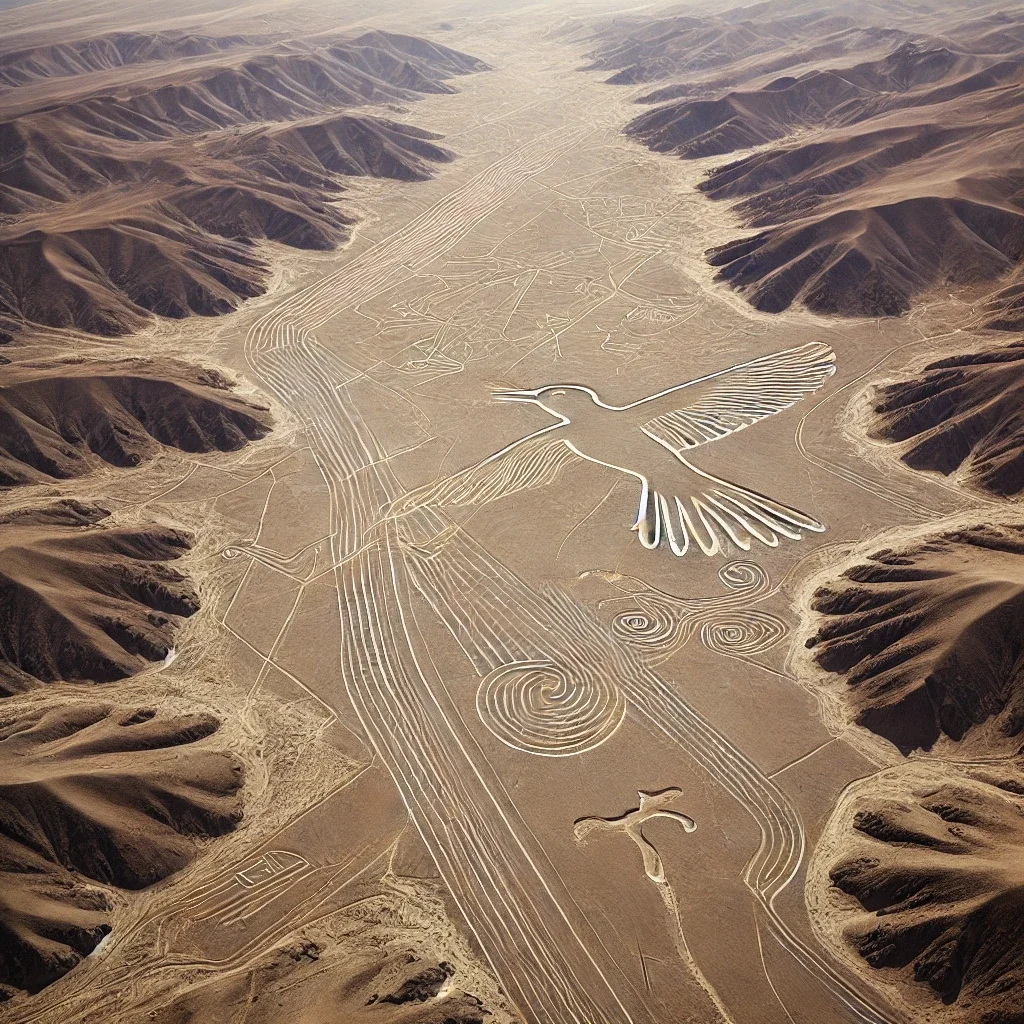
Beneath the scorching Peruvian sun, stretching across the arid plains of the Nazca Desert, lie one of the world’s greatest enigmas: the Nazca Lines. These massive geoglyphs, carved into the earth over 2,000 years ago, remain an unsolved puzzle that continues to baffle archaeologists, scientists, and spiritual seekers alike. Are they ancient astronomical maps, sacred pathways to the gods, or messages left by celestial beings? The truth lies hidden beneath centuries of sand and speculation.
The Scientific Enigma: Engineering of the Ancients
The Nazca Lines, first spotted from above by commercial pilots in the 1920s, consist of over 800 straight lines, 300 geometric shapes, and 70 intricate animal and humanoid figures. But how did the ancient Nazca civilization (200 BCE–600 CE) create these massive designs with such precision, without modern technology?
Scientists believe that the lines were made by carefully removing the reddish-brown iron oxide-coated pebbles of the desert’s surface, revealing the lighter-colored earth beneath. The dry climate and lack of strong winds preserved these lines for millennia. But the biggest mystery remains—how could a pre-Columbian society, without the ability to fly, craft images that can only be fully appreciated from the sky?
One theory suggests that the Nazca people used wooden stakes and rope to create enormous designs by scaling them up from smaller models. Researchers have found evidence of wooden stakes embedded in the ground, reinforcing the idea that the lines were meticulously planned. Another theory postulates that these geoglyphs served as astronomical calendars, aligning with celestial events like solstices and planetary movements.
A Sacred Path to the Gods? The Religious Perspective
To the Nazca people, these lines were far more than mere artistic expressions—they were sacred. Some researchers argue that the geoglyphs were ritualistic pathways, walked upon during ceremonies to appease the gods of rain and fertility. The Nazca civilization depended on agriculture, and the harsh desert environment made water a divine blessing. Theories suggest that the lines were offerings to deities like Kon, the god of wind and rain, or Pachamama, the earth goddess.
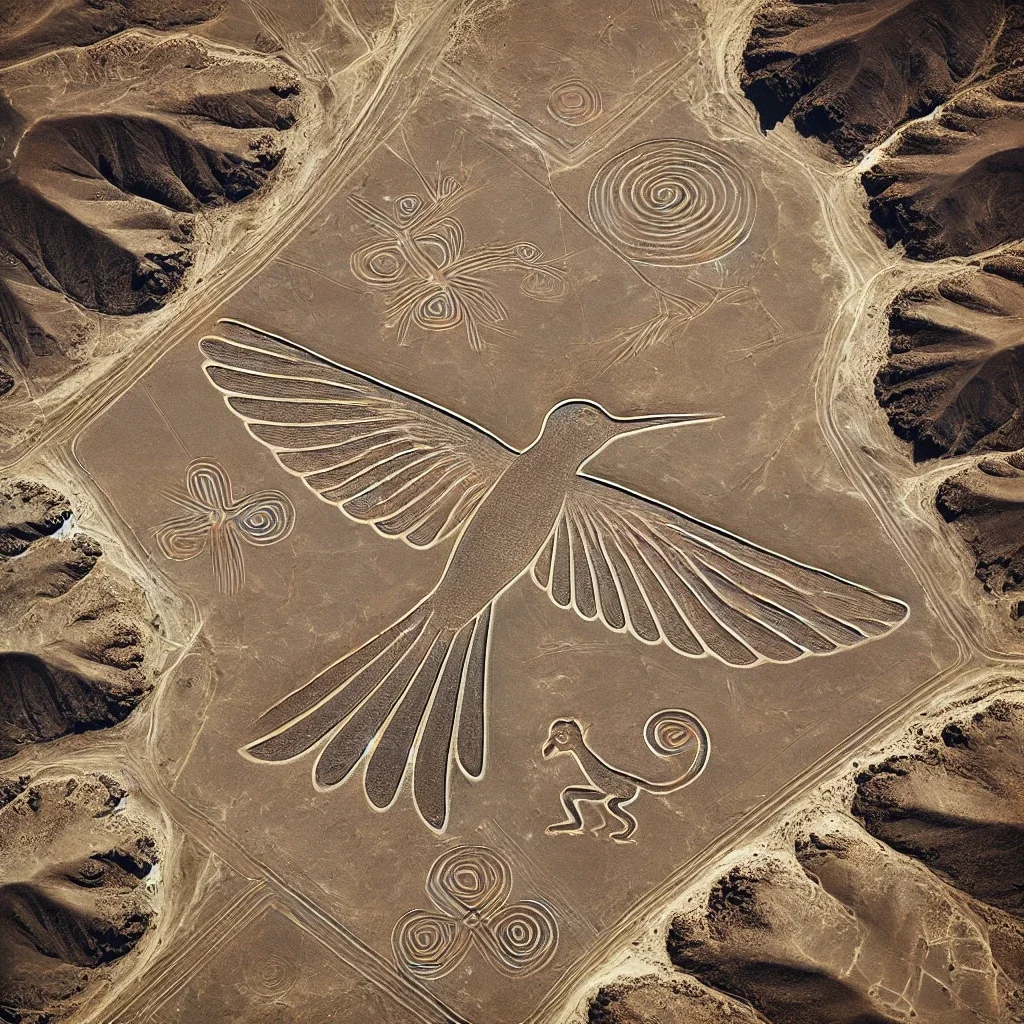
Others propose an even more mystical explanation. The giant figures of a hummingbird, a monkey, a whale, and a spider could represent spirit animals or totemic symbols meant to communicate with celestial beings. The most striking of all is the “Astronaut” figure—a humanoid with large, round eyes, raising a hand toward the heavens. Could this be an ancient depiction of an otherworldly visitor, as some ancient alien theorists suggest?
Celestial Messages or Extraterrestrial Signals?
The mystery deepens when considering theories that link the Nazca Lines to extraterrestrial contact. Erich von Däniken, in his book Chariots of the Gods, speculated that these massive drawings were landing strips or signals for alien visitors. While mainstream scientists reject this idea, the precision and sheer scale of the lines make one wonder—who were they meant for? And why were they drawn in a way that only those in the sky could truly see?
Unraveling the Mystery: A Legacy of Wonder
Despite decades of research, the ultimate purpose of the Nazca Lines remains elusive. Whether they were sacred offerings, astronomical markers, or messages to the beyond, these awe-inspiring geoglyphs continue to spark curiosity and debate. As technology advances, satellite imaging and AI-driven research may one day reveal the full truth of these ancient masterpieces.
For now, the Nazca Lines stand as a testament to human ingenuity, faith, and our eternal connection to the cosmos—a message etched in the earth, waiting for the right eyes to understand.
References
- Aveni, A. (1990). Nasca: Eighth Wonder of the World? Archaeology, 43(2), 36-45.
- Reinhard, J. (1986). The Nazca Lines: A New Perspective on their Origin and Meaning. National Geographic.
- Von Däniken, E. (1968). Chariots of the Gods? Putnam Publishing Group.
- Silverman, H., & Proulx, D. A. (2002). The Nasca. Blackwell Publishing.
- Ruggles, C. (2015). Handbook of Archaeoastronomy and Ethnoastronomy. Springer.



Comments (0)
Leave a Reply
Log in to post a comment.